Jul 10, 2026 • 5 min readLinkedInFacebookTwitter
Rise of the Smart Airport: From Data Silos to Fully Connected Operations
Many airports already have capable systems in place, but those systems often operate independently. The real opportunity lies in breaking down data silos and enabling information to flow across the airport. That’s what transforms a collection of technologies into a truly smart airport. The airports seeing the greatest success are those creating a connected operational ecosystem that links passenger processing, baggage handling, resource management, and operational control into a single source of situational awareness.

By David Jenkins: Business Solutions Manager, Daifuku
According to Airports Council International (ACI) World*, global airport passenger traffic is expected to reach approximately 9.5 billion passengers annually, surpassing pre-pandemic levels and highlighting the continued growth of air travel worldwide. As passenger volumes continue to rise, airports face increasing pressure to deliver seamless passenger experiences while maintaining operational efficiency, resilience, and sustainability.
Airports can no longer operate under the assumption that what worked yesterday will work tomorrow. Travelers expect fast check-ins, shorter waiting times, accurate baggage delivery, clear communication, and minimal disruption. To meet these expectations, airports are increasingly embracing the concept of the smart airport, an interconnected operational ecosystem where automation, the Internet of Things (IoT), artificial intelligence (AI), and real-time analytics work together to improve decision-making and performance.
Why Don’t Traditional Airport Systems Cut It Any Longer?
Historically, airport systems were built and operated independently. Baggage handling, security screening, gate operations, passenger information systems, and operational control platforms have often evolved separately. While these investments may optimize individual functions, they frequently create operational silos that limit visibility and slow decision-making.
Disconnected systems can result in poor communication, delayed responses to disruptions, duplicate data, inefficient resource allocation, and slower passenger processing. As passenger volumes continue to grow, airports that rely on fragmented technologies risk falling behind peers that have embraced connected operations.
The Smart Airport, Defined
A smart airport is a digitally connected operational ecosystem in which systems continuously communicate, share data, and support coordinated decision-making. Rather than reacting to problems after they occur, smart airports leverage technology to anticipate issues and enable proactive decision-making.
Key technologies driving this transformation include IoT devices, AI, machine learning, cloud connectivity, and automation. Together, these solutions provide continuous monitoring, predictive insights, automated workflows, connected asset management, and greater operational visibility.
While AI, IoT, and automation are important enablers, successful airport modernization requires solutions that can operationalize those capabilities. Daifuku helps airports build connected ecosystems through technologies spanning Baggage Handling Systems (BHS), Airport Operation Systems, self-service passenger processing, security screening, resource management, and operational control platforms.
Baggage Handling Systems Help to Power the Smart Airport
One of the most important systems operating behind the scenes is the airport’s BHS. Far more sophisticated than a network of conveyors, modern BHS solutions combine intelligent controls, advanced sortation technologies, baggage tracking capabilities, and operational visibility tools to move baggage efficiently throughout the airport.
Daifuku’s end-to-end airport portfolio includes advanced Baggage Handling Systems, high-speed sortation technology, Early Bag Storage (EBS), conveyors and carousels, checked baggage screening solutions, and integrated control systems. The company’s Airflow and WebbView BHS management platforms provide monitoring, control, operational visibility, and baggage tracking capabilities that help airports improve performance, resilience, and passenger service levels.
The true value of a modern BHS extends beyond baggage movement. Its ability to integrate with broader airport systems, including departure control systems, passenger information systems, security screening platforms, Airport Operations Centers (APOC), and airport operational databases.
Passenger Processing Is Also Part of the Smart Airport
Smart airport initiatives extend far beyond baggage handling. The passenger journey begins long before boarding, making passenger processing technologies an important component of airport modernization strategies.
Daifuku’s passenger processing portfolio includes Common Use Self-Service (CUSS) kiosks, self-check-in solutions, and self-bag-drop technologies that help reduce queues, improve passenger flow, and deliver valuable operational insight.
How Daifuku Supports Smarter Airport Operations
Daifuku helps airports move beyond isolated systems and toward connected operational ecosystems by combining operational software, passenger processing technologies, baggage handling systems, security screening solutions, and lifecycle support services into a unified approach to airport modernization. In addition to BHS, Daifuku offers self-service passenger processing technologies, security screening solutions, airport operating systems, and lifecycle support services.
Key Benefits of the Smart Airport
• Better passenger flow
• Improved baggage movement and tracking
• Enhanced operational visibility
• More efficient use of equipment and infrastructure
• Faster aircraft turnaround times
• Optimized staffing levels
• Improved disruption management
The Future of Airports Is Data and Connectivity
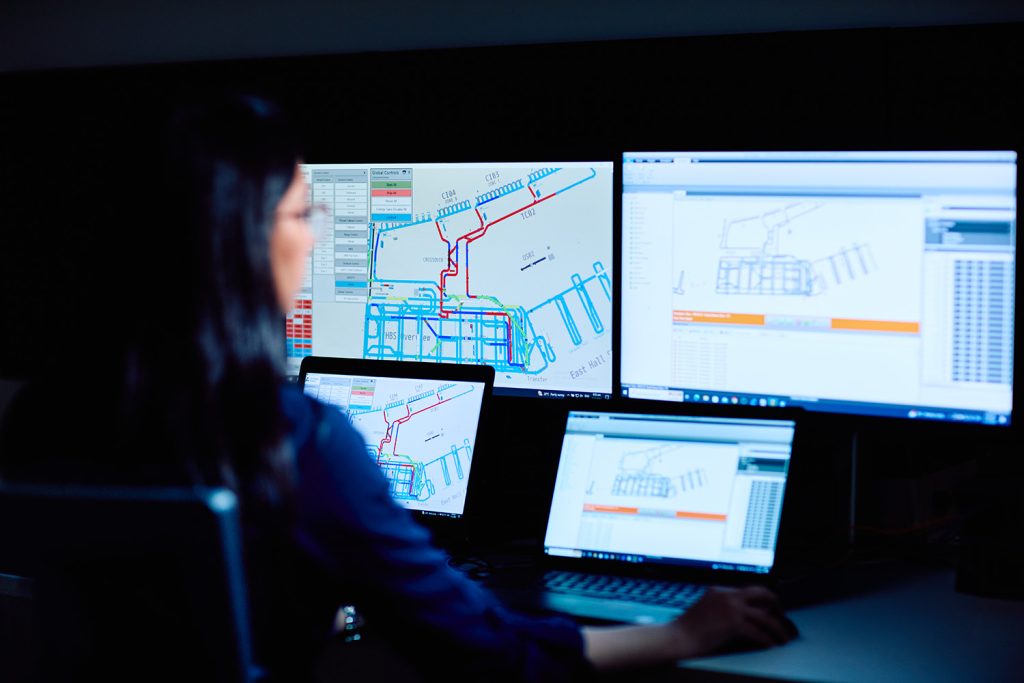
Consider a flight delay. In a connected airport environment, information can flow automatically across operational systems. Flight information updates in real time, baggage routes are adjusted, passenger communications are triggered, ground crews receive updated schedules. This level of cross-functional coordination is increasingly becoming the foundation of modern Airport Operations Centers (APOCs).
APOCs are becoming increasingly more important as airports adopt more connected operating models. By consolidating information from baggage handling, passenger processing, flight operations, resource management, and security platforms, APOC teams can maintain real-time situational awareness and coordinate responses more effectively during disruptions.
Embracing the Smart Airport of Tomorrow
The future airport is not defined by individual technologies operating in silos. It is defined by how effectively those technologies communicate, share data, and work together to support coordinated decision-making.
At Daifuku, we help airports worldwide modernize and optimize their operations through industry-leading BHS, sortation technologies, EBS solutions, passenger processing technologies, security screening platforms, Airport Operation Systems, and advanced control software. More than 500 airport installations worldwide rely on Daifuku technologies to improve productivity, accuracy, operational visibility, and passenger service.
Passenger volumes are on the rise and will likely continue to climb. Airports that invest in connected technologies today will be better positioned to scale, adapt, and meet evolving traveler expectations tomorrow.
For more information about how to begin your smart airport journey, send us a message through our Contact Us page
* Source: https://aci.aero/
Related articles

Jun 26, 2026 • 4 min read
Takeaways from ACI Europe 2026: The Future of Airport Innovation
Feb 14, 2026 • 7 min read
The Hidden Opportunity in IATA 753 Compliance: Why Next-Gen Changes Everything
Newsletter
Never miss an article
Subscribe to our newsletter and be the first in the know.
Join the conversation
For the latest industry articles and networking