Feb 14, 2026 • 7 min readLinkedInFacebookTwitter
The Hidden Opportunity in IATA 753 Compliance: Why Next-Gen Changes Everything
IATA Resolution 753 ensures end-to-end baggage tracking, but its real value extends beyond compliance. Rather than retrofitting point solutions that add complexity, forward-thinking airports are using the mandate to drive operational transformation. Next-generation SCADA platforms like Sym3 integrate baggage, security, and airport operations into a single intelligence layer, enabling predictive decision-making, continuous compliance, and more efficient, resilient performance—turning a regulatory requirement into a strategic advantage.
By David Jenkins: Business Solutions Manager, Daifuku
When IATA Resolution 753 mandated end-to-end baggage tracking, most airports asked: “How do we retrofit our systems to comply?” The smarter question is: “How do we use compliance as a catalyst for operational transformation?”
Here’s the reality: airports that treat IATA 753 as a checkbox exercise will spend millions on point solutions that create new data silos, increase complexity, and deliver minimal operational benefit beyond compliance. Meanwhile, forward-thinking airports are using this mandate to fundamentally reimagine how they operate.
The IATA 753 Mandate: More Than Baggage Tracking
IATA Resolution 753 requires tracking baggage at four critical handover points—check-in, aircraft loading, transfer, and arrival—with the goal of eliminating the 25 million bags mishandled annually worldwide. For airports, this means:
- Real-time data capture across multiple systems
- Seamless integration with airline and ground handler platforms
- Audit trails and traceability across operational boundaries
- Interoperability with existing BHS infrastructure
But here’s what IATA 753 doesn’t solve: fragmented operations, reactive decision-making, and the inability to see patterns across your entire airport ecosystem.
The Evolution of Airport SCADA
SCADA systems have been the backbone of airport operations for decades—and rightly so. They provide essential monitoring and control capabilities that keep critical systems running safely and efficiently. The challenge isn’t with SCADA itself; it’s that many implementations were designed in an era when operational requirements were fundamentally different.
Early airport SCADA excelled at equipment-level visibility and control—monitoring conveyor systems, tracking PLC alarms, managing utilities. These capabilities remain essential. But today’s operational landscape demands more:
- Integration breadth: Connecting not just baggage systems, but security, airside, landside, passenger flow, and facility management
- Operational intelligence: Moving beyond monitoring to predictive analytics and decision support
- Compliance automation: Embedding regulatory requirements like IATA 753 into everyday operations
- Enterprise agility: Rapidly adapting to new requirements without major system overhauls
The airports succeeding today aren’t abandoning SCADA—they’re embracing the next generation of SCADA platforms purpose-built for modern operational complexity.
Sym3: Next-Generation SCADA for the Digital Airport
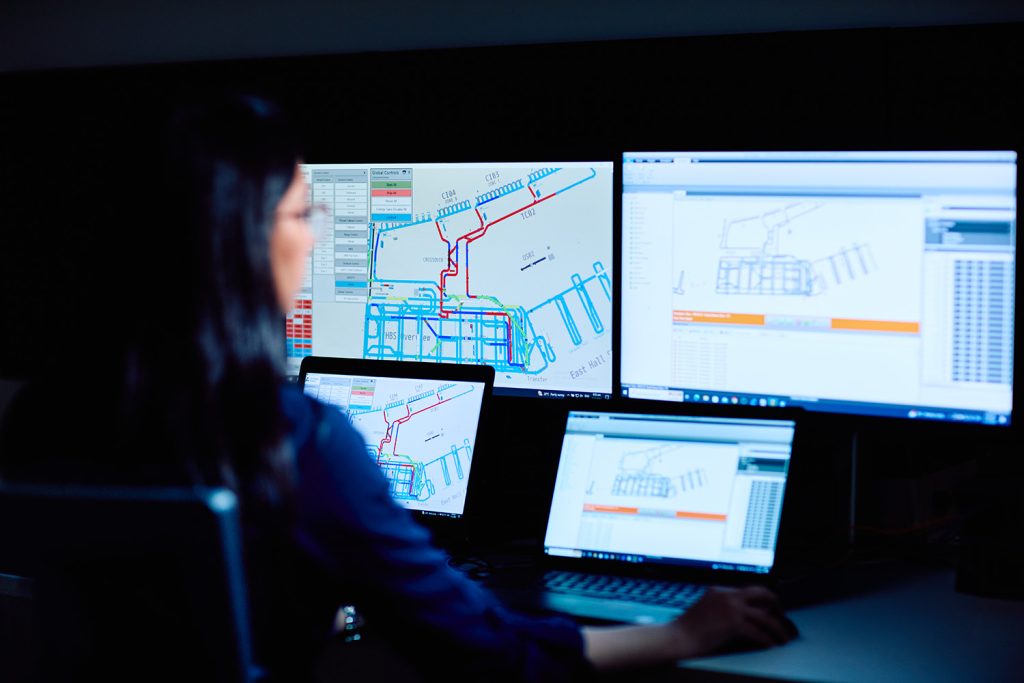
Sym3 represents the evolution of airport SCADA—retaining all the robust monitoring and control capabilities essential to operations whilst adding the intelligence layer required for today’s challenges.
Think of it as SCADA-plus: comprehensive control and monitoring enhanced with operational intelligence, predictive analytics, and enterprise-wide integration.
Compliance
At its core, Sym3 provides enterprise-grade SCADA functionality for baggage handling systems, ensuring IATA 753 requirements are met comprehensively. It natively captures, validates, and shares baggage tracking data across all four touchpoints, integrating seamlessly with existing BHS infrastructure, airline systems, and ground handler platforms.
But meeting compliance is just the starting point.
Operational Intelligence
Where Sym3 differentiates itself is by extending SCADA capabilities across the entire airport ecosystem. By unifying baggage operations with security, airside, landside, utilities, and facility management into a single operational intelligence platform, Sym3 enables:
- Predictive disruption management: Correlate baggage flow patterns with gate changes, security checkpoint volumes, and aircraft turnaround status to anticipate problems before they cascade.
- Cross-domain optimisation: Automatically adjust BHS throughput based on real-time security queue data and flight schedules.
- Compliance with context: IATA 753 tracking data enriched with operational intelligence—see not just that a bag missed its connection, but why (security delay? late check-in? airside congestion?).
Real-World Scenario
Morning rush. Security queues surge unexpectedly. Bags are accumulating faster than staff anticipated.
- Traditional SCADA approach: BHS operators monitor conveyor systems and see congestion developing. Security management monitors queue lengths. Airport operations tracks flight punctuality. Each system provides accurate data, but each domain operates independently.
- Sym3 approach: The platform correlates all three operational data streams in real-time, predicts downstream baggage bottlenecks before they materialise, proactively alerts relevant teams with actionable insights, suggests resource reallocation based on historical patterns, and tracks whether interventions achieved desired outcomes—all whilst maintaining continuous IATA 753 compliance tracking seamlessly in the background.
Beyond Single-System SCADA
What makes Sym3 transformational isn’t replacing your existing systems—it’s connecting them intelligently:
- BHS SCADA: Comprehensive monitoring and control with predictive maintenance
- Security systems: Integration with access control, CCTV, and checkpoint management
- Airside operations: Stand allocation, ground handling coordination, FOD management
- Landside systems: Car parks, terminal facilities, passenger flow monitoring
- Utilities and facilities: Energy management, HVAC, lighting, building systems
Each domain retains its specialised SCADA functionality whilst contributing to enterprise-wide operational visibility.
Built for Retrofit, Designed for the Future
Sym3’s architecture recognises that airports can’t rip and replace their operational infrastructure. Instead, it’s designed to work with what you have:
- Legacy integration: Connect with existing BHS controllers, PLCs, and operational systems without disruption.
- Modular deployment: Implement by domain—start with baggage compliance, expand to other operations as needed.
- Cybersecurity-first: Built to CAA and TSA cybersecurity frameworks for critical infrastructure protection.
- Future-ready architecture: Foundation for digital twins, AI-driven optimisation, and emerging technologies.
- Open ecosystem: Standard APIs and protocols enable integration with next-generation solutions.
From Monitoring to Strategic Intelligence
The evolution from traditional SCADA to platforms like Sym3 isn’t about abandoning proven technology—it’s about enhancing it with the intelligence layer modern airports require.
Legacy SCADA tells you what’s happening in your systems. Sym3 tells you what’s happening across your operations, what’s likely to happen next, and what you should do about it—all whilst maintaining the robust monitoring and control capabilities that keep airports running safely.
The APOC Vision
Forward-thinking airports are moving towards integrated Airport Operations Centres (APOCs)—unified command centres where all operational domains work from shared situational awareness. Sym3 provides the technological foundation for this vision, serving as the central nervous system that connects previously siloed systems into a coherent operational picture.
This isn’t just about technology integration. It’s about enabling your teams to make better decisions faster, backed by comprehensive data and intelligent analytics.
The Bottom Line
IATA 753 compliance is mandatory. But how you achieve it—and what operational capabilities you build whilst meeting that requirement—determines whether you’re simply keeping pace or establishing operational advantage.
Airports implementing Sym3 don’t just tick the compliance box. They reduce operational costs, improve passenger experience, enhance safety and resilience, and create a foundation for continuous innovation.
The question isn’t whether you need robust SCADA capabilities—you absolutely do. The question is whether your SCADA platform provides only monitoring and control, or whether it delivers the operational intelligence required to excel in today’s environment.
Meeting IATA 753 is just the beginning. Where Sym3 takes you next is the real story.
To speak with a Business Solutions Manager in assessing your current operational flow, contact the team here.

About David Jenkins
David Jenkins is a strategic commercial leader with over two decades of experience driving digital transformation and scalable growth across multiple sectors. He has delivered significant success in aviation technology, including leading SaaS-based solutions for airport operations and passenger experience optimisation. David’s career spans high-impact roles in EMEA, where he has defined and executed strategies for global expansion, revenue optimization, and digital innovation. His expertise includes building partnerships, unlocking new revenue streams through data-driven platforms, and shaping future-ready solutions for complex operational environments. Passionate about leveraging technology to solve real-world challenges, David continues to influence the evolution of smart, connected ecosystems in aviation and beyond.
Email david.jenkins@daifukuoc.com or connect with David here.
About Daifuku
Daifuku is a global leader in end-to-end airport operations, working closely with airports and airlines to deliver seamless, data-driven passenger and baggage experiences. With decades of expertise in baggage handling systems, digital airport solutions, and passenger self-service technologies, Daifuku helps partners optimise performance, strengthen operational resilience, and elevate the passenger journey.
From CUSS kiosks to self check-in, self bag drop, and advanced visualisation systems like Sym3 and Airport Operations Systems, Daifuku delivers trusted, future-ready solutions that enable airports and airlines to operate smarter, faster, and more efficiently.
Related articles

Jul 14, 2023 • 3 min read
The Total Cost of Ownership with Baggage Handling Systems
Newsletter
Never miss an article
Subscribe to our newsletter and be the first in the know.
Join the conversation
For the latest industry articles and networking